
CT Scans
Advanced computed tomography imaging.

Unveiling detailed insights with computed tomography.
At St. Luke’s Radiology, computed tomography (CT) scans are a cornerstone of our advanced diagnostic imaging services. CT technology utilizes a sophisticated combination of X-rays and computer processing to generate highly detailed, cross-sectional images of your body’s internal structures, including bones, soft tissues, and blood vessels. This powerful imaging modality provides a level of detail far beyond conventional X-rays, allowing our expert radiologists to detect and diagnose a wide range of conditions with exceptional precision. From identifying subtle fractures to evaluating complex internal injuries and staging various diseases, CT scans play a critical role in guiding accurate diagnoses and effective treatment plans. We are committed to providing rapid and accurate CT imaging, ensuring that you and your physician receive the vital information needed for timely medical decisions.
Understanding CT scans
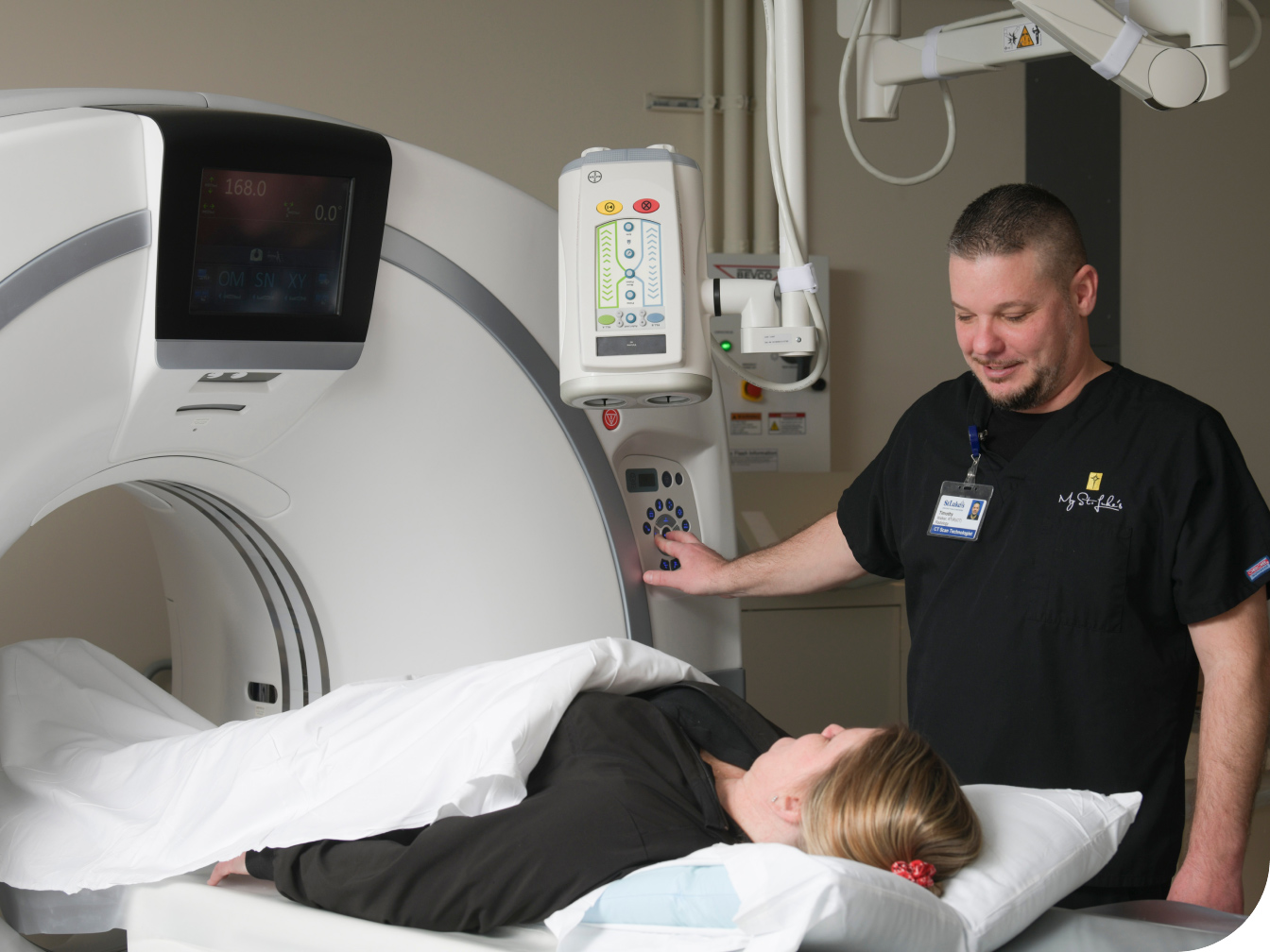
A CT scan involves lying on a table that slides into a large, donut-shaped machine. As the table moves, an X-ray tube rotates around your body, taking multiple images from different angles. A computer then processes these images to create detailed 2D slices and 3D reconstructions of the area being examined. This process is quick and generally takes only a few minutes for the actual scan.
- Emergency diagnostics: Rapidly identifies internal injuries, bleeding, and other critical conditions in trauma cases.
- Bone and joint imaging: Provides detailed views of complex fractures, spinal problems, and joint diseases.
- Cancer detection and staging: Helps detect tumors, determine their size and location, assess spread, and monitor treatment response.
- Vascular studies: Visualizes blood vessels to detect aneurysms, blockages, and other vascular conditions.
- Organ evaluation: Offers clear images of organs like the lungs, liver, kidneys, and pancreas to diagnose infections, inflammation, or masses.
Why choose St. Luke’s for your CT scan?
Choosing St. Luke’s for your CT imaging means entrusting your care to a team dedicated to diagnostic excellence and patient comfort.
- State-of-the-art technology: We utilize advanced CT scanners that provide high-resolution images with optimized radiation dose, ensuring both diagnostic quality and patient safety.
- Expert radiologists: Our board-certified radiologists possess extensive experience in interpreting CT scans across all body systems, providing accurate and timely reports to your physician.
- Efficient and comfortable experience: We strive to make your CT scan as quick and comfortable as possible, with clear instructions and supportive staff throughout the process.
- Integrated care: Our imaging services are seamlessly integrated with your overall healthcare plan, ensuring that your CT results contribute directly to your comprehensive treatment strategy.
Frequently asked questions about CT scans
The CT scanner consists of an X-ray machine and a detector that spins around the body. The detector records the X-ray information at every position. The complex computer system processes the information to produce a picture of what the inside of the body looks like.
The actual scanning process for a CT scan is typically very fast, often taking only a few minutes. The entire appointment, including preparation, may take longer.
CT scans are used to diagnose a wide range of conditions, including internal injuries, fractures, tumors, infections, and vascular diseases. They provide detailed cross-sectional images of bones, soft tissues, and blood vessels.
CT scans are generally painless. You will lie still on a table, and the machine will move around you. If contrast material is used, you might feel a warm sensation or a metallic taste in your mouth.
Yes, CT scans use X-rays, which involve a small amount of ionizing radiation. St. Luke’s uses the latest technology to minimize radiation exposure while maintaining diagnostic image quality.
Just like an X-ray, a CT scan can only work if the patient is administered a small dose of radiation. While radiation exposure has been shown to increase the risk of getting cancer later in life, the increased risk to a person from one CT scan is extremely small. Most estimates suggest the increased lifetime risk of cancer from one CT scan would be between about 0.1 and 0.01%.
St. Luke's takes radiation safety very seriously, adhering to all American College of Radiology guidelines. St. Luke’s continually updates technology so that we have the latest and safest CT scanners, and ensures the lowest radiation dose possible is used to get a patient's accurate diagnosis.
Preparation depends on the type of CT scan. You may be asked to fast for a few hours before the scan, especially if contrast material is used. Specific instructions will be provided by your physician or our scheduling team.
There are two kinds of contrast – one taken by mouth and the other by intravenous catheter, or IV. Each may be used as part of the CT scan study to help make a diagnosis by giving the radiologist and the referring doctor a clearer picture of what may be happening inside a patient's body.
- The kind of contrast a patient drinks is often used when a doctor wants to know what is happening in a patient's abdomen and pelvis, because this contrast is visible in the stomach and intestines on the scan.
- The kind of contrast injected into an IV catheter may be used for scans of practically any part of the body and can help a radiologist see tumors, infections or abnormalities that can cause a patient's symptoms.
The contrast a patient drinks is extremely safe, and many patients even claim that it doesn’t taste as bad as they expected.
The contrast that is injected into an IV line is generally safe. In rare instances, some patients can have an allergic reaction to it. For that reason, our trained technologists always ask about a history of allergies and keep a close watch for any symptoms of developing allergy. We avoid giving intravenous contrast to patients who may have the onset of kidney failure. Your doctor may ask that you get some labs drawn prior to getting a CT scan when IV contrast will be used.

Schedule your CT scan today
When detailed internal imaging is crucial for your diagnosis and treatment, trust St. Luke’s Radiology for your CT scan needs. Our commitment to advanced technology, expert interpretation, and patient-centered care ensures you receive the highest quality diagnostic services. Don’t delay in getting the answers you need; accurate CT imaging is a vital step toward managing your health effectively.