From predictive analytics and clinical decision support to generative AI tools that improve efficiency and patient care, St. Luke’s University Health Network has built one of the most advanced and practical artificial intelligence programs in health care.
What began as a focused effort to improve patient safety has evolved into one of the nation’s most ambitious and innovative uses of artificial intelligence in health care.
Over the past several years, St. Luke’s has leveraged artificial intelligence (AI), advanced analytics and machine learning to improve quality, enhance clinical decision-making, streamline operations and support caregivers across its rapidly growing health system. Today, the Network is recognized as an industry leader in applying AI technologies in ways that deliver measurable value for both patients and providers.
“It’s been a joy to work with SLUHN as they’ve consistently been early adopters of Epic’s AI capabilities, thoughtfully putting them to work in ways that improve the experience for patients, clinicians, and staff,” said Kevin Guerrero, Epic’s Technical Coordinator for St. Luke’s.
Long before the recent surge of public interest in generative AI, St. Luke’s was investing in artificial intelligence tools embedded within its Epic electronic medical record platform to identify high-risk patients and improve clinical outcomes.
“Before AI became a buzzword, we were already using it to help solve real clinical problems,” said Charles Sonday, Associate Chief Information Officer at St. Luke’s. “Our work began with sepsis prediction and early intervention. We learned how to combine data, clinical expertise and technology to identify patients at risk and intervene sooner. That foundation set the stage for everything we've built since.”
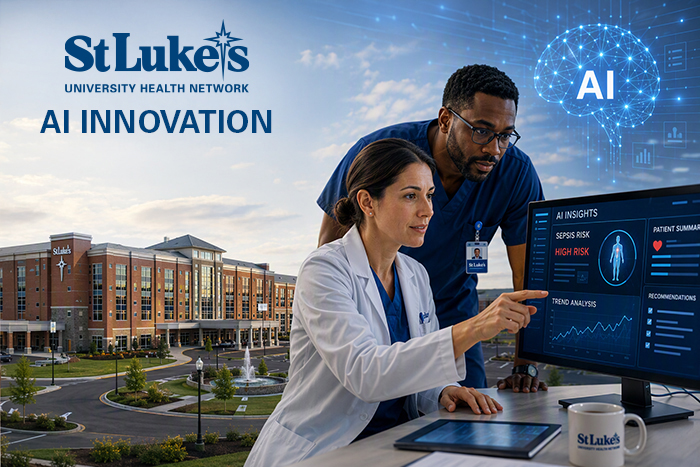
One of the earliest successes involved the use of advanced predictive models to detect signs of sepsis, a life-threatening medical condition. St. Luke’s enhanced Epic’s native capabilities while also developing customized solutions that incorporated real-time patient data, including vital signs and clinical indicators. The initiative demonstrated how AI could augment clinical teams, helping providers make faster, more informed decisions.
Since then, St. Luke’s has expanded its AI strategy across multiple areas of the organization.
Today, clinicians and leaders use AI-powered tools to analyze vast amounts of clinical and operational data, identify trends, automate routine tasks and support decision-making. The Network is also evaluating and implementing generative AI technologies that help caregivers work more efficiently while reducing administrative burden.
“Our philosophy has always been practical innovation,” Sonday said. “Artificial intelligence should solve real problems, improve outcomes and make life easier for patients and caregivers. We focus on technologies that create meaningful impact rather than simply adopting the latest trend.”
A key advantage in St. Luke’s AI journey has been the strong data infrastructure supporting these initiatives. The Network has developed a sophisticated enterprise data environment that allows teams to securely manage and analyze information across the organization.
That work has been strengthened through collaborations with leading technology partners that provide expertise in cloud computing, data engineering and advanced analytics.
“If you don’t have the data, you can’t do AI,” Sonday said. “Building the right data foundation has been critical to our success. It allows us to develop, test and deploy innovative solutions at scale while maintaining the highest standards for quality and security.”
The Network’s approach reflects a broader commitment to innovation that has helped St. Luke’s become a nationally recognized health system. In 2025, the U.S. Department of Health and Human Services found St. Luke’s to be one of the nation’s top three health systems for quality, safety and patient experience.
By closely aligning technology initiatives with clinical and operational priorities, St. Luke’s has created a framework that enables responsible AI adoption while maintaining a focus on patient-centered care.
As health care organizations across the country explore how artificial intelligence can transform medicine, St. Luke’s continues to expand its portfolio of AI-enabled solutions and identify new opportunities to improve the patient experience.
“Artificial intelligence will continue to play a growing role in health care,” Sonday said. “But technology alone is not the answer. Success comes from bringing together clinicians, data scientists, engineers and operational leaders to solve problems collaboratively. That’s the culture we’ve built at St. Luke’s, and it’s what positions us to remain at the forefront of innovation.”
With a proven track record of deploying AI solutions that improve care, increase efficiency and support caregivers, St. Luke’s is helping define what the future of health care innovation looks like today.
What began as a focused effort to improve patient safety has evolved into one of the nation’s most ambitious and innovative uses of artificial intelligence in health care.
Over the past several years, St. Luke’s has leveraged artificial intelligence (AI), advanced analytics and machine learning to improve quality, enhance clinical decision-making, streamline operations and support caregivers across its rapidly growing health system. Today, the Network is recognized as an industry leader in applying AI technologies in ways that deliver measurable value for both patients and providers.
“It’s been a joy to work with SLUHN as they’ve consistently been early adopters of Epic’s AI capabilities, thoughtfully putting them to work in ways that improve the experience for patients, clinicians, and staff,” said Kevin Guerrero, Epic’s Technical Coordinator for St. Luke’s.
Long before the recent surge of public interest in generative AI, St. Luke’s was investing in artificial intelligence tools embedded within its Epic electronic medical record platform to identify high-risk patients and improve clinical outcomes.
“Before AI became a buzzword, we were already using it to help solve real clinical problems,” said Charles Sonday, Associate Chief Information Officer at St. Luke’s. “Our work began with sepsis prediction and early intervention. We learned how to combine data, clinical expertise and technology to identify patients at risk and intervene sooner. That foundation set the stage for everything we've built since.”
One of the earliest successes involved the use of advanced predictive models to detect signs of sepsis, a life-threatening medical condition. St. Luke’s enhanced Epic’s native capabilities while also developing customized solutions that incorporated real-time patient data, including vital signs and clinical indicators. The initiative demonstrated how AI could augment clinical teams, helping providers make faster, more informed decisions.
Since then, St. Luke’s has expanded its AI strategy across multiple areas of the organization.
Today, clinicians and leaders use AI-powered tools to analyze vast amounts of clinical and operational data, identify trends, automate routine tasks and support decision-making. The Network is also evaluating and implementing generative AI technologies that help caregivers work more efficiently while reducing administrative burden.
“Our philosophy has always been practical innovation,” Sonday said. “Artificial intelligence should solve real problems, improve outcomes and make life easier for patients and caregivers. We focus on technologies that create meaningful impact rather than simply adopting the latest trend.”
A key advantage in St. Luke’s AI journey has been the strong data infrastructure supporting these initiatives. The Network has developed a sophisticated enterprise data environment that allows teams to securely manage and analyze information across the organization.
That work has been strengthened through collaborations with leading technology partners that provide expertise in cloud computing, data engineering and advanced analytics.
“If you don’t have the data, you can’t do AI,” Sonday said. “Building the right data foundation has been critical to our success. It allows us to develop, test and deploy innovative solutions at scale while maintaining the highest standards for quality and security.”
The Network’s approach reflects a broader commitment to innovation that has helped St. Luke’s become a nationally recognized health system. In 2025, the U.S. Department of Health and Human Services found St. Luke’s to be one of the nation’s top three health systems for quality, safety and patient experience.
By closely aligning technology initiatives with clinical and operational priorities, St. Luke’s has created a framework that enables responsible AI adoption while maintaining a focus on patient-centered care.
As health care organizations across the country explore how artificial intelligence can transform medicine, St. Luke’s continues to expand its portfolio of AI-enabled solutions and identify new opportunities to improve the patient experience.
“Artificial intelligence will continue to play a growing role in health care,” Sonday said. “But technology alone is not the answer. Success comes from bringing together clinicians, data scientists, engineers and operational leaders to solve problems collaboratively. That’s the culture we’ve built at St. Luke’s, and it’s what positions us to remain at the forefront of innovation.”
With a proven track record of deploying AI solutions that improve care, increase efficiency and support caregivers, St. Luke’s is helping define what the future of health care innovation looks like today.