St. Luke's University Health Network's Department of Community Health is celebrating 30 years of service and partnership dedicated to improving health outcomes and addressing the needs of
communities throughout eastern Pennsylvania and western New Jersey.
Established in 1996, the Department of Community Health was created to provide a sustainable, community-centered approach to improving health and well-being beyond the walls of the hospital. Over the past three decades, the department has grown into a regional leader in addressing social determinants of health through strategic partnerships, resource navigation, workforce development and community-based initiatives designed to improve health equity.
"Thirty years ago, St. Luke's recognized that improving health required working alongside the community to address the factors that influence well-being long before someone enters a doctor's office," says Rajika Reed, Ph.D., MPH, M.Ed., Vice President of Community Health. "Today, that commitment remains stronger than ever. Our success has been built on trusted partnerships and a shared vision that every person deserves the opportunity to achieve their best health. We are proud of what we've accomplished over the past three decades."
The anniversary is one of three major milestones being celebrated by St. Luke's programs in 2026. St. Luke's Hospice is commemorating 40 years of compassionate care while the St. Luke's Nurse-Family Partnership marks its 25th anniversary.
Today, the Department of Community Health's work is guided by its mission to create pathways for equity toward measurable health outcomes through advocacy, access and navigation of resources for partners and underserved communities. The department envisions a community where everyone has access to exceptional health care built on a foundation of trust and compassion.
The Department of Community Health oversees the St. Luke's Community Health Needs Assessment (CHNA), a comprehensive process conducted every three years to identify the region's most pressing health challenges and guide community investment. The department works closely with local organizations, schools, municipalities and community members to develop solutions that address both immediate needs and long-term health outcomes.
The current priorities, identified through the CHNA process, include improving access to care, preventing chronic disease and promoting mental and behavioral health. Access to care remains the Network's foremost community health priority, recognizing the impact that transportation, housing, food security, employment and resource navigation can have on an individual's ability to obtain needed health services.
Over the years, the Department of Community Health has expanded its reach through a broad range of initiatives focused on community and school-based navigation and partnerships, workforce development, adolescent mentoring and other efforts designed to connect individuals and families with the resources they need to thrive. These initiatives support St. Luke's commitment to creating sustainable pathways to better health across the communities it serves.
The department's impact extends across every community served by all 16 St. Luke's hospitals. Community Health Liaisons support local initiatives in each campus community, ensuring that strategies are tailored to local needs while advancing the Network's broader goals of access, prevention, wellness and partnerships.
One of the department's longest standing and most impactful initiatives has been its partnerships with school communities. Since its founding, St. Luke's has collaborated with school districts to identify and address barriers affecting student success, family well-being and community health. Through the community school model, St. Luke's helps connect students and families with health, social and community resources while fostering collaborative partnerships that support educational achievement and overall wellness.
This commitment is exemplified through St. Luke's longstanding partnership the Bethlehem Area School District (BASD), a collaboration that began when the Department of Community Health was founded.
"Their [the Department’s] commitment to a whole-child approach recognizes that student success depends on more than what happens in the classroom," said Eric Fontanez, BASD's Supervisor of Equity Initiatives. "Together, we've worked to ensure that students and families have access to the support systems that help them learn, grow and reach their full potential."
Through St. Luke's Community Health Department, Marvine Elementary has access to a community school coordinator who connects families with resources ranging from healthy food and fitness opportunities to mental health and social services.
"If we see a student who may be struggling with basic needs, the community school coordinator helps connect that family with resources such as a local food pantry or mental health services," said Fontanez. "At Marvine, we have a food pantry that St. Luke's supports not only in its mission, but with volunteers who help organize it so families can easily access what they need."
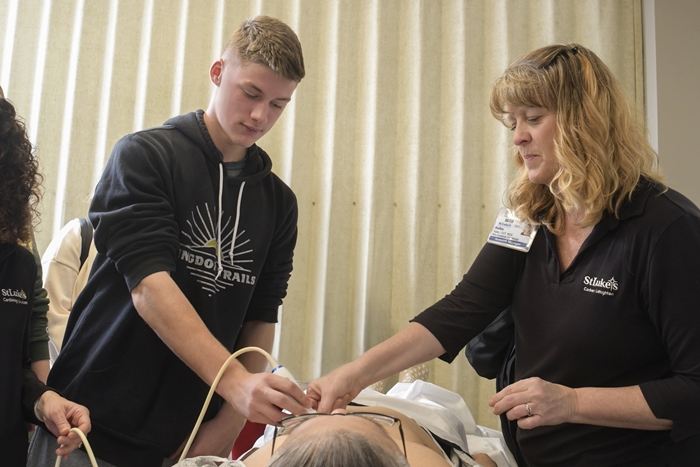
Beyond connecting students and families to essential resources, the Community Health Department helps inspire the next generation of health care professionals through a variety of educational and workforce development programs. These include a Health Career Exploration program for high school students interested in health care careers and the School-to-Work Program for ESOL (English-for-speakers-of-other-languages) students. Over 800 students have participated in the mentorship programs since inception of the initiative.
Community health is about more than health care, Reed explained. "It is about creating the conditions that help people live healthier lives. For 30 years, we have worked alongside our communities to remove barriers, build trust and develop meaningful solutions. That work will continue to guide us for decades to come."