
Resources
What is a chaplain?
Chaplains serve as key players in interdisciplinary care-giving teams providing spiritual care to people of all faiths and no faith. Chaplains respect the personal beliefs and values of people in their care - without imposing a specific religious view.
- For patients - any hospital staff person can request a chaplain visit on your behalf.
- For St. Luke’s staff - text via EPIC Rover the direct role for your campus chaplain or Network Chaplain Supervisor On Duty. A complete directory can be found in AMION.
- Death or anticipated death
- Deteriorating condition
- Life changing or traumatic events.
- Ethical dilemmas
- End of life decision making (Advanced Directives, DNR orders)
- Family Support (communication, divisions, breakdown in support systems)
- Requests for prayer, sacraments, or clergy
- Patient transfer to another hospital campus
- Emotional or spiritual distress around issues such as:
- Guilt
- Forgiveness
- Anger
- Anxiety
- Meaning of life
- Grief
- Suffering
- Questioning G-D
Bethlehem Campus Labyrinth
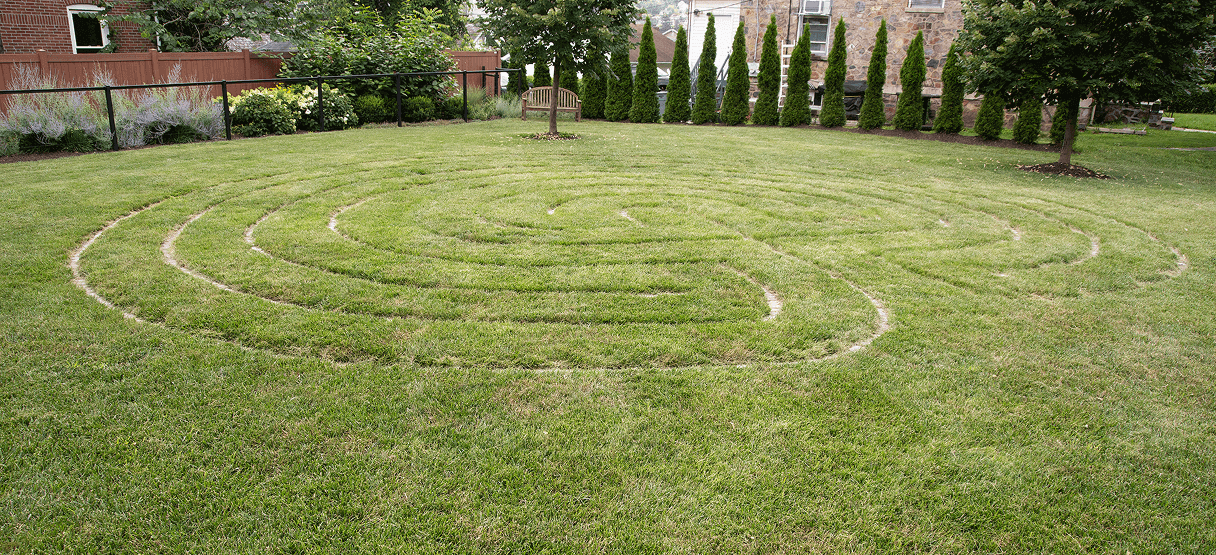
The St. Luke’s Bethlehem’s (SLB) Labyrinth on Ostrum Street, across the street from the School of Nursing. Designed by Tom Fiorini, Director of Landscape Services, and built by his team, it is beautifully and simply made with stone on a grass pathway.
Labyrinths are an ancient symbol representing life’s journey. The oldest discovered labyrinth was found on a clay tablet in Greece, circa 1200 B.C.E., known as the “classical seven-circuit Cretan labyrinth.” The SLB labyrinth was built with this design in mind!
Labyrinths today are increasingly found in health care settings, retreat centers and houses of worship. Multi-disciplinary clinical literature about the use of labyrinths in healthcare settings site these therapeutic benefits:
- Walking meditation
- Coping tool
- Use of silence for self-awareness
- Problem-solving
- Calmness and breathing techniques
- Cognitive functioning and healing
A labyrinth differs from a maze in that it does not have dead ends, forks or obscured visibility. A labyrinth has one way into the center and the same way out. How you walk it and what your goal is differs with each walk and each person. You might walk it to clear your mind or focus your breathing. You might enter it with an intention or a prayer and “leave it” in the center, or you might enter it with a concern or a question and “receive” clarity in the center or on your way out.
In the Medieval period, churches such as Chartres in France began building walkable labyrinths out of inlaid stone in intricate and multi-quadrant and multi-circuit patterns to use for religious pilgrimages, both indoor and outdoor and in varying shapes and sizes. All styles of labyrinths have been discovered in caves and ancient structures, on coins and tablets, and within many spiritual, religious and native traditions. The number of circuits and quadrants are said to be based on symbols in sacred geometry. In a maze, many choices must be made. In a labyrinth, there is only one choice to be made: whether to enter or not.
Mindfulness
Mindfulness, the practice of being present and fully engaged in the moment, can greatly benefit your wellbeing. It helps reduce stress, anxiety, and emotional distress, promoting a sense of calm and control, even in challenging situations. Mindfulness also enhances emotional resilience, supports mental clarity, and fosters a more positive mindset, which can aid in recovery from illness and improve your overall quality of life. Integrating mindfulness into patient care offers a holistic approach to healing that addresses both body and mind.
Incorporating mindful pauses into daily life can be a simple yet transformative practice. These short moments of intentional breathing and awareness help reset the mind and body, reducing feelings of overwhelm. Mindful pauses allow you to step out of the mental spiral of worry or fear and return to a state of calm. Whether it's taking a few deep breaths before a procedure or focusing on the present moment to reset your nervous system, these brief pauses can alleviate stress, improve emotional regulation, and promote a sense of peace amidst uncertainty. By integrating mindful pauses, you gain a valuable tool for navigating everyday challenges with greater ease and clarity.
Short mindfulness practices to reset
The following guided mindful practices are between 2-3 mins. They can help you to check in with yourself, calm your nervous system and generally take care of yourself throughout the day.
Give yourself the benefit of a short mindful break by clicking on one of the guided practices:
- Grounding: This grounding exercise supports you to feel more connected to the present moment and less overwhelmed by strong emotions or distressing thoughts.
- Deep Breathing: Deep breathing is scientifically proven to reset your nervous system, calming your body and mind.
- Mindful Pause: This short body awareness practice supports you to pause and reset during a busy day.
- Mindful self-compassion break: What if you treated yourself as you would your best friend. This brief practice introduces compassion when you are struggling and in pain.
- Two Minute Breathing Space: An exercise you can do in between the many other things in your busy day.
- Mindful Stretch: A simple, 3-minute mindful stretching practice that blends gentle movement with mindfulness to promote relaxation and body awareness.
If you have questions, please contact St. Luke’s Mindfulness Educator, Padma Fanning, at Collette.Fanning@sluhn.org.
Clinical Pastoral Education (CPE)
Our CPE programs offer innovative trauma-informed curriculum and place a strong emphasis on spiritual integration, interdisciplinary engagement, and care-giver resilience.
- Persons in ministry and/or ministry training
- Clergypersons and laity who wish to become Board-Certified Chaplains
- Persons seeking ordination in faith groups that require CPE as a prerequisite.
- Care-providers from other professional disciplines who seek to deepen the spiritual dimension of care as a part of their work with clients and families. At this time, St. Lukes’s is unable to accept international CPE applicants.
Interested in a career in spiritual care? St. Luke’s offers an CPE internship and residency programs.