St. Luke’s University Health Network is leading the way in spine care and bringing today’s most advanced technology to pediatric scoliosis surgery at St. Luke’s Children’s Hospital in Bethlehem. By combining 3D navigation and robotic assisted tools, surgeons at St. Luke’s are making scoliosis surgery safer, more precise and more reliable for children. St. Luke’s is ranked #1 for quality, safety and patient experience by the U.S. Department of Health and Human Services.
What Does Robotic Assisted Surgery Mean for Children?
One of the most important and delicate parts of scoliosis surgery is placing small screws into bone that correct the spine deformity. Navigation and robotic-assisted technology help surgeons plan each step in advance and place these screws with exceptional accuracy.
Research shows that these tools can:
- Improve precision during complex spine procedures
- Reduce variations during surgery
- Enhance overall safety for children undergoing scoliosis correction
For families, this means greater confidence that surgery is being performed with the highest level of accuracy available today.
A National Leader in Pediatric Spine Care
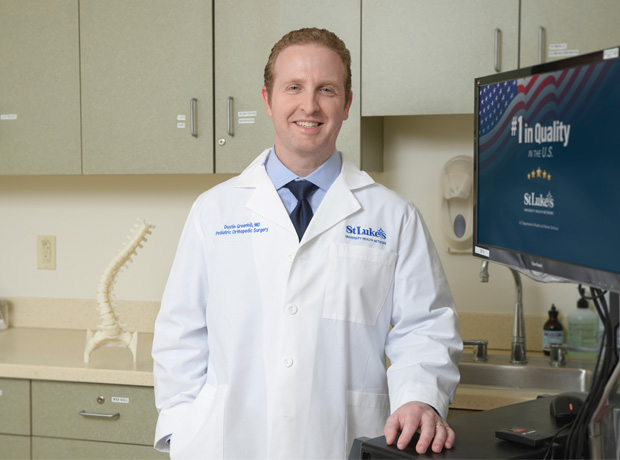
St. Luke’s ability to offer this advanced care is built on a strong foundation of orthopedic and neurosurgical expertise. According to Dustin Greenhill, MD, a pediatric orthopedic surgeon at St. Luke’s Children’s Hospital, the Network is now part of a national, multi center group of pediatric orthopedic surgeons from some of the nation’s top children’s hospitals focused on improving outcomes in pediatric scoliosis surgery. Together, the group has demonstrated excellent outcomes using navigation and robotic assisted techniques in scoliosis surgery.
“You simply cannot achieve this level of success without an exceptional health system behind you,” says Dr. Greenhill, who serves as:
- Associate Program Director, St. Luke’s Orthopedic Surgery Residency Program
- Clinical Research Director, St. Luke’s Orthopedic Care
- Chair, American Academy of Orthopaedic Surgeons Pediatric Content Committee
In this national leadership role, Dr. Greenhill helps guide education and research that advances pediatric orthopedic care for surgeons and patients around the world.
Advancing Care Through Education and Research
St. Luke’s commitment goes beyond clinical care. Medical students from the Temple/St. Luke’s School of Medicine are actively involved in studying and evaluating navigation and robotic assisted scoliosis procedures.
“Our students are helping analyze our outcomes and contribute to meaningful research,” Dr. Greenhill explains. “Their work has already earned national recognition.”
Most recently, student research abstracts were accepted and displayed at the 2025 International Pediatric Orthopaedic Symposium (IPOS), a reflection of the high quality learning and clinical environment at St. Luke’s.
Looking Ahead
As technology continues to advance, both national research and St. Luke’s own patient outcomes show that navigation and robotic assisted surgery will play an increasingly important role in caring for children with scoliosis. These innovations support safer procedures, more precise correction and consistent results, helping children get back to doing what they love.