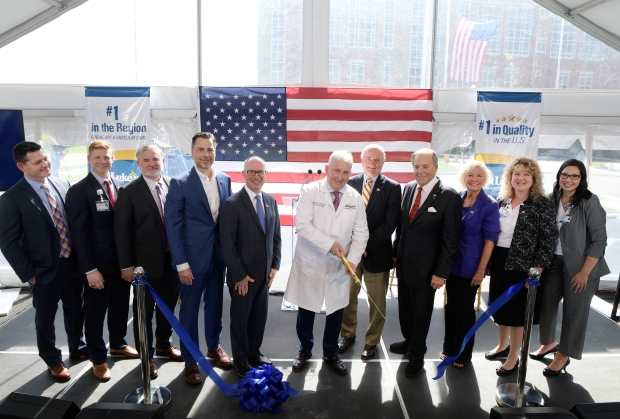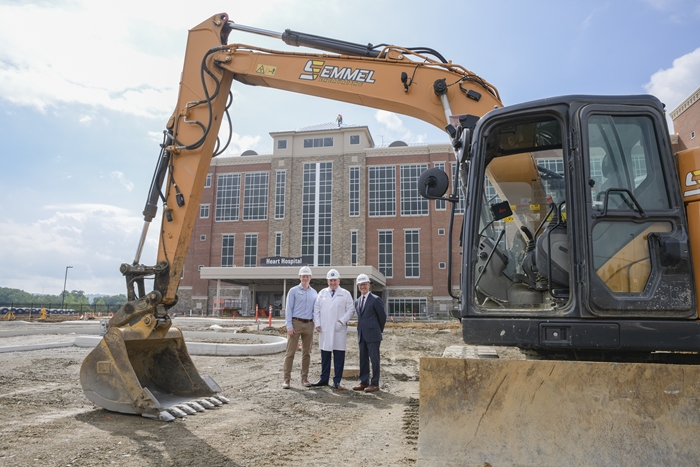
St. Luke's University Health Network is pleased to announce/unveil its new St. Luke's Heart Hospital – opening at St. Luke's Anderson Campus in October!
The $252 million Heart Hospital is the largest construction project in St. Luke's more than 150-year history, both in terms of dollar figure and square footage.
The five-story, approximately 355,000-square-foot facility, constructed entirely of American steel, is seamlessly integrated into St. Luke’s Anderson Campus. A central corridor on each of the upper floors stretches 330 feet — roughly the length of a football field.
Construction began in 2024 and has employed hundreds of skilled workers. Once fully operational, the Heart Hospital will support hundreds of permanent, family-sustaining healthcare jobs.
The new facility will provide patients with convenient access to the full spectrum of St. Luke's nationally recognized cardiovascular services, including four dedicated heart operating rooms, one hybrid operating room, ten advanced interventional suites for cardiac catheterization, electrophysiology and interventional radiology, in addition to a specially designed cardiac intensive care unit providing high-acuity heart patients advanced specialized care.
Additionally, the Heart Hospital will be fully equipped with the latest, most innovative equipment and technologies to best treat our cardiac patients. This includes brand new, state-of-the-art imaging equipment to see and assess the most intricate heart issues, heart-lung machines to take over pumping blood during open-heart surgeries and extracorporeal membrane oxygenation (ECMO) machines to provide patients with continuous, long term cardiopulmonary support.
Despite its size and complexity, the project was completed at a relatively low per-square-foot cost by industry standards, a testament to St. Luke's extensive experience in hospital construction. In recent years, St. Luke's has built five full-service acute care hospitals — more than any other health system in Pennsylvania.
Designed to support learning and innovation, the Heart Hospital furthers St. Luke's educational mission through expanded teaching space and a new cardiac fellowship program. It also incorporates numerous design innovations intended to improve efficiency and enhance patient experience. For example, internal service corridors provide staff access to supplies and other support areas, facilitating better workflow.
The facility also includes features that will improve flow and otherwise benefit the broader Anderson Campus, including a rooftop helipad and a new larger cafeteria.
Located on a 500-acre campus overlooking the Lehigh River, St. Luke's Anderson Campus opened 15 years ago as Pennsylvania's first new full-service acute-care hospital in four decades.
Since then, the campus has continued to expand to meet the region's healthcare needs. The original campus included a state-of-the-art cancer center and medical office building. In 2017, the addition of a $26 million Specialty Pavilion added new specialty services and an Ambulatory Surgery Center. In 2020, the $90 million Women & Babies Pavilion opened, introducing labor and delivery services, a neonatal intensive care unit (NICU), graduate medical education space and a simulation teaching center, while doubling the size of the existing hospital.
The new Heart Hospital adds 140 beds and nearly doubles the size of the Anderson Campus yet again.
The Anderson Campus is also home to the St. Luke's Rodale Institute Organic Farm, which supplies fresh produce to St. Luke's hospitals, as well as an extensive network of popular walking trails. During the summer and fall, the campus's iconic sunflower and cosmos fields attract thousands of visitors from across the region.