skip to main menu skip to content skip to footer
If you have an emergency, call 9-1-1 or go to the nearest emergency room.

NEWS & STORIES AT ST. LUKE'S

St. Luke's Marks 10 Years of Innovation with Masimo Continuous Monitoring Technology

calendar_today Apr 02, 2026

schedule 6 min. read

verified Medically verified by Aldo Carmona, MD and Charles J. Sonday, DNP

Dr
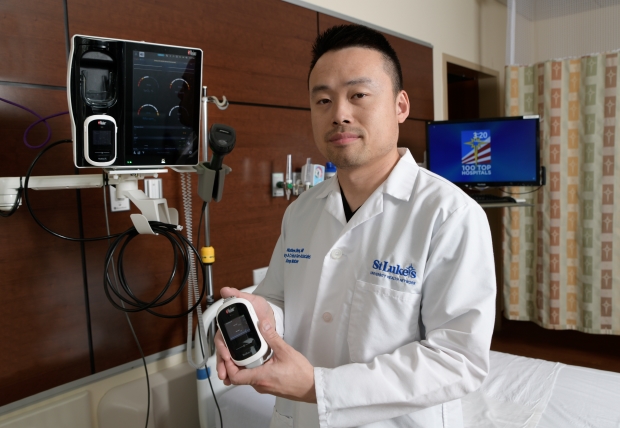
Dr. Matthew Zheng shows the Masimo monitor.

St. Luke’s University Health Network is marking a decade of leadership and transformation in patient safety through its innovative use of Masimo continuous monitoring technology, an advancement that has helped the Network become the #1‑ranked health system for quality, safety and patient experience according to the U.S. Department of Health and Human Services.

Over the past 10 years, St. Luke’s has implemented Masimo hardware and software across all medical‑surgical units and other areas that do not require one‑to‑one nursing care. Patients in these units wear a noninvasive Masimo device that continuously monitors vital signs, enabling care teams to identify early signs of deterioration and reduce transfers to the ICU, sepsis rates, code events, readmissions, and complications associated with sedatives or narcotics.

“A patient can be on a floor at our Miners Campus, and if they are starting to show signs of sepsis, it will trigger an alert in our remote Virtual Response Center,” said Aldo Carmona, MD, Senior Vice President of Clinical Integration and Chairman of Anesthesiology. “It’s mind‑boggling to realize that all our patients are getting the same level of monitoring, the same level of scrutiny. There has been a zero incidence of central nervous system injuries from sedatives or narcotics since the system’s implementation.”

Daniel Candillon, MD, Chief Medical Officer of Masimo, said, “Such powerful innovation in health care delivery will undoubtedly continue to fuel this unique and historic partnership as we introduce the next generation of wearable sensors and novel disease-detection algorithms into their trusted hands.”

The foundation of St. Luke’s system for patient safety is Masimo’s Root® Patient Monitoring and Connectivity Platform, complemented by the Masimo Patient SafetyNet™ (PSN), which provides continuous supplemental monitoring and real‑time clinical notification. When a patient’s vital signs move outside customized safety parameters, PSN automatically alerts caregivers, functioning as an early‑warning system that helps prevent emergencies before they become more challenging and even potentially fatal crises.

Dr

St. Luke’s further advanced the system by engineering a direct connection between Masimo technology and its Epic electronic medical records.

“We were the first in the nation to map Masimo to Epic and their predictive models,” explained Charlie Sonday, St. Luke’s Chief Associate Medical Officer and CMIO of Medical Informatics. “Epic had not engineered that, so we did that with them, and that was a major engineering feat to figure out how to map the live data feeds into a predictive model.”

St. Luke’s first introduced Masimo technology through a small pilot program on a high acuity trauma floor. After demonstrating strong clinical value during subsequent rollouts, the system expanded across the Network. During the COVID‑19 pandemic, PSN played a critical role by allowing nurses to monitor patients remotely, reducing unnecessary exposure. St. Luke’s also used the technology to remotely monitor more than 6,000 patients at home.

Thanks to St. Luke’s exceptional care and innovations, the Network was significantly more successful at saving the lives of COVID-19 patients than many other health care systems and hospitals nationwide. A statistical analysis of hospital data drawn from more than 1,300 U.S. hospitals by PINC AI™, a leading technology and services platform owned by Premier Inc., showed that St. Luke’s saved 700 more COVID-19 patients than would have been the case if the Network had performed similarly to a typical U.S. hospital.

Today, every patient in a medical‑surgical unit is monitored for oxygen saturation and pulse rate around the clock, with nurses adding blood pressure, temperature and respiratory rate. All data flows automatically into the electronic medical record. If a reading falls outside the safe range, PSN immediately notifies the appropriate nurse so they can respond at once.

Beyond reporting numbers, the system identifies trends and early indicators of patient deterioration. By recognizing subtle changes in heart rate, oxygenation and blood pressure, PSN can issue alerts for sepsis risk or other clinical concerns. This predictive capability allows teams to intervene early, thereby improving outcomes and preventing crises.

The benefits have been significant. For instance, a PSN alert recently notified a nurse that a patient’s oxygen level had fallen to 70%; fast intervention helped save the patient’s life. Since adopting the system, St. Luke’s has achieved:

  • 24% fewer medical-surgical cardiac arrests by FY2025, with 92 cumulative arrests prevented from FY2023–FY2025
  • 38% survival-to-discharge in FY2025, nearly 69% better than the 22.5% national benchmark
  • 147 total lives saved or prevented over four fiscal years, including 55 additional lives saved and 92 averted cardiac arrests, relative to the national benchmark, plus 91 ICU transfers avoided in FY2025 alone

 “All of these patients have a Masimo Root System Monitor in each room, and that’s the connection into Epic,” said Dr. Carmona.

The technology alone cannot achieve this level of safety. “You need a culture where teamwork truly exists,” said St. Luke’s Chief Quality Officer Donna Sabol. “Masimo in isolation isn’t going to make this happen. You need the buy-in of your nursing staff, your leaders and your financial people, because this is an investment that provides better care for our patients.”