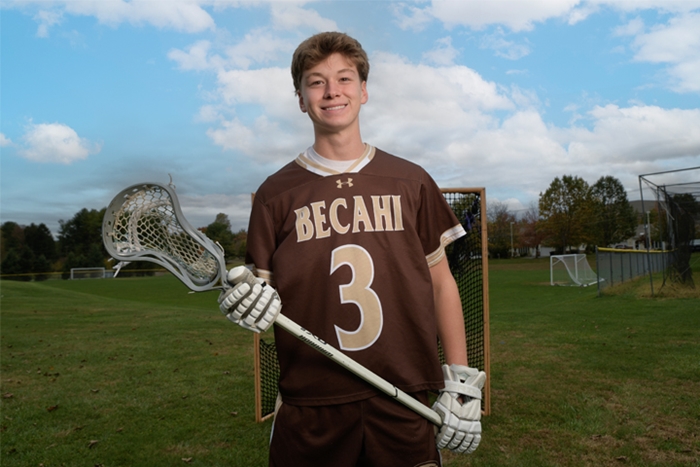
For Gavyn Moyer, knee surgery initially sounded frightening. A multi-sport athlete at Bethlehem Catholic High School, Moyer faced a long recovery and challenging rehab process. And he couldn’t play lacrosse, his favorite sport. But six months after having arthroscopic surgery at St. Luke’s Orthopedic Hospital, Moyer played soccer and golf for the Golden Hawks last fall and is preparing for his final season of lacrosse in the spring. Even better, he won’t worry about having arthritis when he’s 20.
Moyer, a 17-year-old senior, sustained a serious meniscus tear while wrestling last winter. It’s known as a bucket-handle tear and occurs most commonly in young athletes who hyperextend their knees. In Moyer’s case, his right medial meniscus remained attached to the knee joint but essentially flipped over toward the center of the knee. It looked like an inverted bucket handle, hence the injury’s name.
A bucket-handle tear is a significant injury for anyone but can be life-changing for young athletes. The meniscus (or menisci, since each knee has two) serves as cushion between the thigh and shin bones. Meniscus injuries not only cause serious pain and restrict knee movement but also can accelerate symptoms of arthritis.
That’s why Dr. Scott Doroshow of St. Luke’s Orthopedic Care recommended surgery. Dr. Doroshow, an orthopedic sports medicine surgeon, performed the arthroscopic procedure in February at St. Luke’s Orthopedic Hospital-West End Campus. He returned the meniscus to its proper position and stitched it into place with minimal incisions.
“When you tear your meniscus, unfortunately it doesn’t heal on its own,” Dr. Doroshow said. “There isn’t great blood supply to it, and the two ends of the meniscus where it's torn get physically separated. Your body can't quite bridge the gap without the stitch holding it together. So, without surgery, you're just accepting a meniscus tear, which is typically painful and hard to live with. And with less of a shock absorber, you will develop arthritis.”
Dr. Doroshow explained to a reluctant Moyer and his family that surgery would return him to the field as if the injury never happened. It also would significantly lower the risk of developing early arthritis.
Following the procedure, Moyer faced a significant recovery process that began with six weeks on crutches and light jogging by the third month. He approached rehab at Physical Therapy at St. Luke’s in Northampton with a positive spirit and desire to return to the field quickly.
“It was a pleasure working with Gavyn as he faced the challenge of returning to a demanding, competitive sport after a complex knee injury and surgery,” said Maria DeBlasio, DPT. Gavyn exemplifies the ideal student-athlete—always positive, engaged and motivated to give his best throughout rehab. He patiently adhered to post-operative restrictions, one of the toughest parts of recovery for most athletes. Once cleared for weight-bearing, his strong work ethic and determination propelled him safely and efficiently back toward lacrosse.”
Now fully healed, Moyer looks forward to playing lacrosse in college. He also wants to study medicine.
“He’s doing great,” Dr. Doroshow said. “He has no pain, is back to playing sports at full strength, and is not having any issues with the knee.”
In December, St. Luke’s Orthopedic Hospital West End Campus is celebrating its second anniversary of providing comprehensive orthopedic and sports medicine services to the community. The team is committed to helping athletes of all ages and skill levels restore mobility, regain speed and strength, and enhance their quality of life.