Anyone who ever had to wear a traditional plaster cast during a healing period probably remembers a bulky, heavy and uncomfortable cast wrapped around their skin for weeks or months. Even today’s fiberglass casts can be itchy, trap odors and are difficult to keep clean and dry.
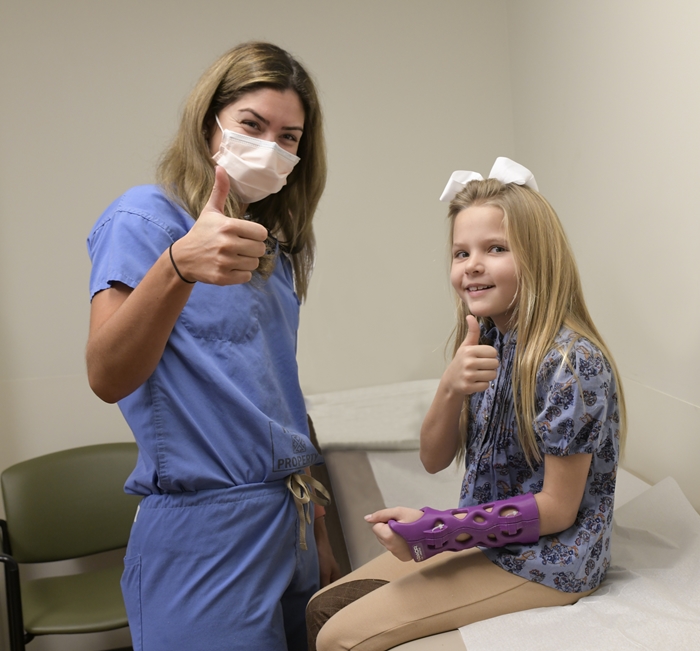
Those days may soon be over, thanks to new technology created by ActivArmor, of Colorado, that creates a removable, waterproof and durable 3-dimensional plastic cast. The casts have been employed at St. Luke’s Orthopedic Care for more than a year.
This month, St. Luke’s became the first in the nation to use its in-house 3D Print and Innovation Lab to produce ActivArmor casts for upper extremity injuries. The casts are typically covered by medical insurance, including Medicare and Medicaid.
Dustin Greenhill, MD, pediatric orthopedic surgeon at St. Luke’s Orthopedic Care, has been instrumental in deploying this new technology. “For an active child and their parents, weeks in a cast can feel like months,” he said. “I want them out of a traditional cast as soon as possible, but also need to protect the arm when kids go back to being kids. This cast lets me do both.”
With this technology, Greenhill said, “we can now get these 3D casts on kids fast – both for stable fractures that simply need to heal and, more recently, unstable injuries. For preadolescents and adolescents with a severe wrist or forearm fracture, I’m now doing their 3D scan during surgery.”
ActivArmor founder and CEO Diana Hall said that her company is “excited to work with some of the top innovators in orthopedics at St. Luke's to bring this next-generation technology to market. St. Luke's reputation for quality, service and patient satisfaction align perfectly with our mission at ActivArmor: to improve the safety and quality of life for those requiring immobilization while healing.”
The ability to produce the casts in-house is a game-changer for patients, said Megan Augustine, MS, Network Director of St. Luke’s Simulation Center, which includes the 3D Print and Innovation Lab. Augustine researched and spearheaded the introduction of ActivArmor to St. Luke’s Orthopedics Department by working directly with Hall. After visiting the Colorado-based company and working through hardware and software issues, she was able to bring this technology to patients of the St. Luke’s network.
“We initially launched a small-scale roll out that allowed us to scan the patient for the cast, upload the file and have it printed by ActivArmor in Colorado and then have it sent to us, which was typically a four-day turnaround,” Augustine said. “I asked Diana to let us know when she was ready to have the 3D printing done onsite, because we wanted to be the first in providing this type of quality care with a quicker turnaround to our patients. And now, we are currently delivering the cast in two business days. We expect to cut that down to same day delivery in the very near future, which is exactly want our patients want.”
In fact, the ActivArmor option is so popular with patients and parents that many even know about it before they are offered the option, said Kylie Honnick-Payne, a physician assistant who works with Dr. Greenhill. “Some of them heard about it from other kids, and they’re asking us for one before we even decide it’s an option,” she said. “The kids just love it.”
The capacity to produce the casts in-house adds an additional layer of convenience. “Instead of having to wait a week for a custom cast to be made and shipped, we can literally have it in hours,” Honnick-Payne said. “We are starting to scan certain (surgical) patients for it in the operating room, prior to surgery, and have it ready for them when they need it. It is just so much more convenient for the patients and their parents.”
Jessica Kamensky, the service line administrator for Musculoskeletal Services at St. Luke’s, says the patients who are able to experience injury recovery using the ActivArmor casts appreciate its flexibility. “We found that the younger population, especially, gravitate to them. The device can start fastened and then transition to something that is more like a brace that can be easily removed. Kids can play with it on, bathe with it on…..it’s just so much more practical than a traditional cast.”