
 Quality Awards
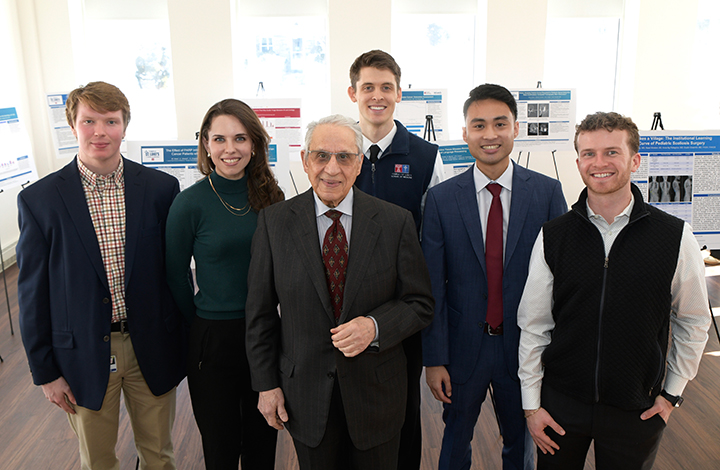
Temple/St. Luke’s medical students stepped into the spotlight at Santo Longo Research Day on January 30, sharing their podium and poster presentations at the Priscilla Payne Hurd Education Center at the Bethlehem Campus. As the region’s first and only four-year medical school, the Temple/St. Luke’s School of Medicine fosters a culture of mentorship, bringing students and physicians together in meaningful scholarly partnership.
Designed as a showcase of student inquiry and discovery, the afternoon invited faculty, staff, and community to explore a wide range of original projects. This was the second year that the event was named for Angie and Dr. Santo Longo, a beloved St. Luke’s pathologist and student mentor whose support of medical education through the Medical Scholarship Endowment Fund helps provide opportunities for qualifying students who are in good academic standing, demonstrate a commitment to medical research and publication, and who have completed the summer research work-study program.
“Dr. Longo’s enthusiasm for learning and commitment to asking thoughtful questions continues to shape our academic community. His example reminds us that meaningful progress in medical science begins with curiosity, persistence, and a willingness to explore the unknown,” shared Kurt Tio ’28.
In preparation for Research Day, Dr. James Anasti, Temple/St. Luke’s Director of Clinical Curriculum and Research, surveys attending physicians and Temple/St. Luke’s faculty for research topics and presents them to the class at the beginning of each academic year. Once topics are selected, students break out into teams mentored by a clinician investigator in their field of interest.
“For me, Research Day is all about curiosity; to help a student learn to ask questions and answer them is priceless for me,” said Anasti. “Bringing someone into the research world helps them foster that curiosity, and that curiosity is part of what will make them a better doctor.”
Five students were selected to give podium presentations of eight minutes each, with accompanying slides:
Katherine O’Neill-Knasick ’28 spoke about the risk of developing thyroid storm – a rare life-threatening emergency where the thyroid gland releases excessive hormones – during pregnancy.
Peyton Kimmel ’27 focused on the promise of intravascular lithotripsy (IVL) in treating heavily calcified peripheral arterial lesions that are often resistant to conventional therapies.
Will Faunce, III ’28 shared his investigation into contrast dose reduction in head and neck CTAs with dual-energy scanners.
Coleman Cush ’27 discussed his findings on whether the use of NSAIDs, rather than opioids, after spinal fusion surgery decreases necessary bone formation.
Nikolas Pham ’28 talked about the danger around co-prescribing both benzodiazepines and opioids and how holding provider education sessions aimed to reduce the risks around co-prescribing.
Following the podium presentations, the 35 students who were involved in research shared their posters and were available for questions and conversation in nearby classrooms.